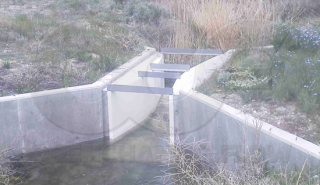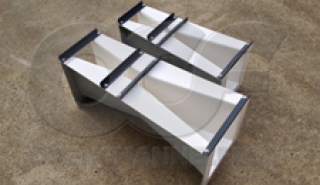

We often talk about how flumes and weirs accelerate sub-critical flow to a supercritical state and how that in turn develops the level-to-flow relationships that are used to determine the flow rate. In the past we’ve defined the various stages of critical flow by the Froude number (Fr).
- Fr < 1, flow is sub-critical
- Fr = 1, flow is critical
- Fr > 1, flow is super-critical
We've also stated before that the Froude number should generally not exceed 0.5, as above this number standing surface waves are prone to form.
But what we haven’t delved into is how exactly we determine the Froude number.
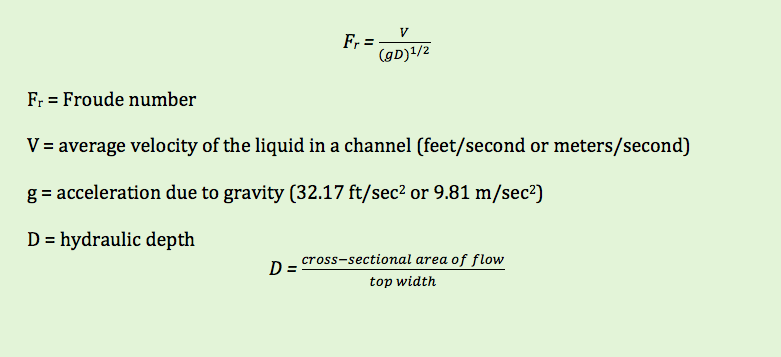
Froude Number Equation
The Froude number is defined as follows:
Example
A rancher needs to install a flume in a channel to measure his water right and he knows the following information:
- Channel shape: Rectangular
- Channel depth: 1-feet (at maximum flow)
- Channel width: 3-feet
- Flow rate: 9-cubic feet/sec (which gives us a velocity of 3-cubic feet/sec as Q (flow rate) = A (area) * V (velocity), A = 3*1)
From this the Froude number can be calculated as:
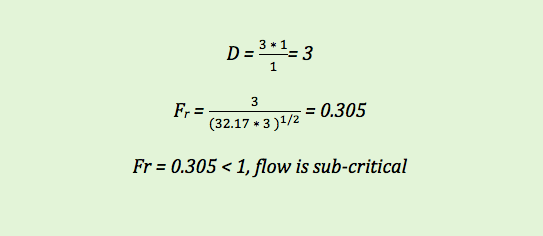
With the Froude number verified, the rancher can proceed with the installation of the flume to measure his water right.