
Flow Stream Turbulence
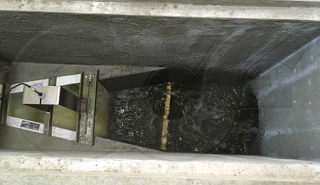
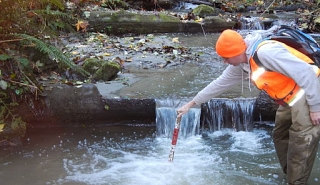
Turbulence results from relatively small volumes of water spinning in random patterns as the body of water moves downstream. Turbulence can be recognized as boils on the water surface or three-dimensional eddies in the flow stream, which appear and disappear randomly. Because this motion is local in the general flow, any particle of water can be moving forward, backward, sideways, or vertically with respect to the flow's general direction.
Weeds along the banks or riprap slumps into the flow stream can be sources of turbulence, as can sediment deposits. Obstructions that intrude into the flow area or discontinuities in the channel dimensions / elevation can also be sources of turbulence.
Effect on Accuracy
While turbulence is inherent in most flow systems, excessive turbulence and rough water conditions can cause measurement errors of 10 to 20 percent - or more - as it can make it extremely difficult to determine the flow head accurately. For accurate flow measurement, all visible signs of turbulence must be eliminated upstream from a measuring device.
Controlling Surface Turbulence
A rough water surface can usually be controlled by reducing surface turbulence or improving the approaching velocity profile. A rough water surface can make it difficult to read a staff gauge. It can make it difficult for a flow meter to determine the actual water level (ultrasonic meters being particularly susceptible to this).
Stilling wells can reduce errors in head measurements, but every attempt should be made to reduce or eliminate water surface disturbances before relying on a stilling well.
Sometimes it is necessary to resort to specialty wave-dampening devices to obtain a smooth water surface. Underflow wave suppressors can be particularly effective in smoothing the water surface, and they have been successfully used on both small and large channels.
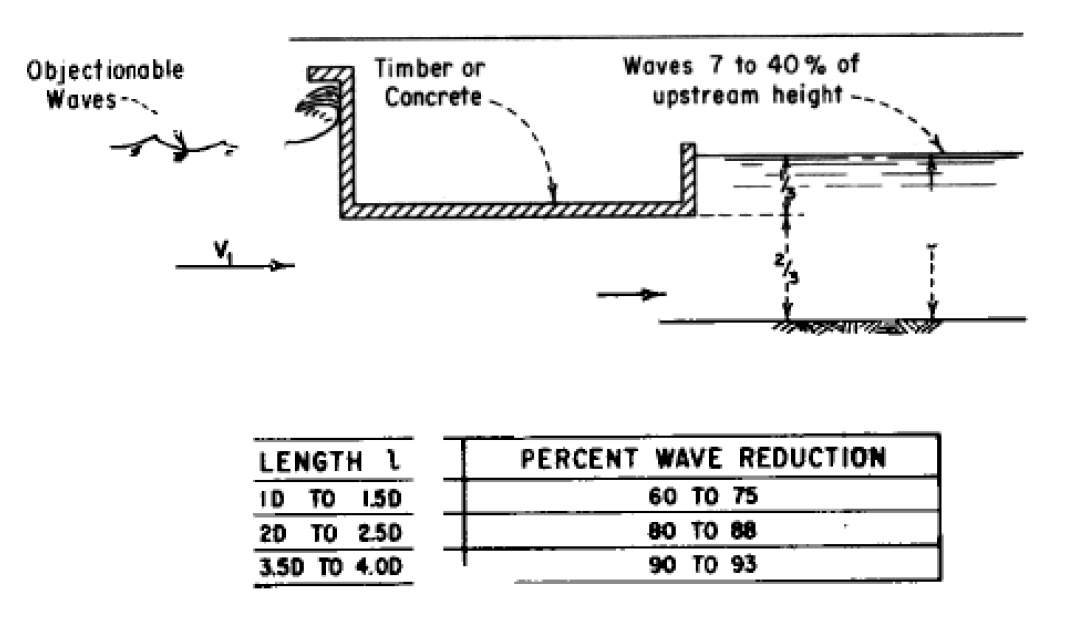
Waves may be reduced by up to 93 percent when using an underflow wave suppressor - with maximum results coming when the underflow section's length is 3.5 to 4 times the depth of the flow. It should be noted that underflow wave suppressors generate a small backwater effect.
Depending upon the channel's width and the wave suppressor's size, the suppressor may span the channel, or it can be supported on piers and constructed from wood, concrete, or other suitable material. It should be noted that the wave suppressor does not need to be watertight.