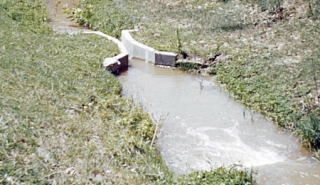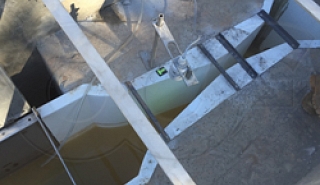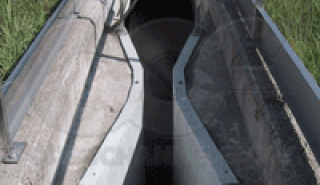

While the Parshall flume is the most commonly used flow for measuring the flow of water in open channels, the flume does have some distinct disadvantages:
Empirical Device
The Parshall flume is an empirical device and the flow equations / discharge characteristics must be determined through empirical (laboratory) testing for each flume.
Not Scale Models
While similar in design and layout, Parshall flumes are not scale models of each other. As a result, non-standard (i.e. 30-inch) sizes must be independently rated as much flume that are not fabricated to the published dimensions.
Drop Floor
In a Parshall flume, as the flow exits the converging section and enters the throat, the floor of the flume drops in elevation. This drop means that Parshall flumes are not as easily installed in existing channels as some other flume types: either the flume must be set above the channel floor (creating a potential freeboard issue upstream) or the channel must be modified (increasing installation costs).
Large Size
Shaped like an hourglass, the Parshall flume can occupy quite a bit of space – much more so than more compact flume types. As a result, it can be difficult to find sufficient room to install the flume. As the flumes get larger, they must be fabricated off-site (in multiple pieces) or they must be constructed on-site (not always possible).
No Intermediate Sizes
As discussed above, Parshall flumes are not scale models of each other. As result, should an intermediate size of flume be needed, either a custom (field rated) flume would have to be constructed, or the next largest standard size flume would have to be used.