
 There are six standard angles for V-notch weirs:
- 22-1/2º
- 30º
- 45º
- 60º
- 90º
- 120º
but from time to time this range of sizes is not enough.
Sometime there is a need to correct for a weir plate cut at an incorrect angle. While other times the flows of a particular site don’t match up well with the flow characteristics of the standard sizes of V-notch weirs.
Regardless of the reason, there is a need to be able to calculate discharge equations for intermediate V-notches.
For V-notches between 25 and 100 degrees, the Kindsvater-Shen relationship can be applied to calculate the free-flow discharge equation (Kulin and Compton).
The equation is as follows:
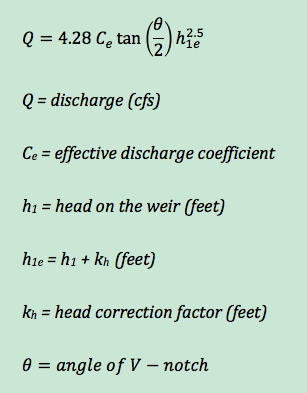
The effective discharge coefficient, Ce, and the head correction factor, kh, can be obtained from the charts below (BSI):
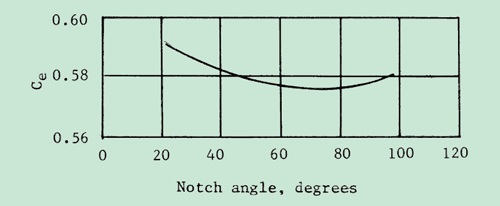
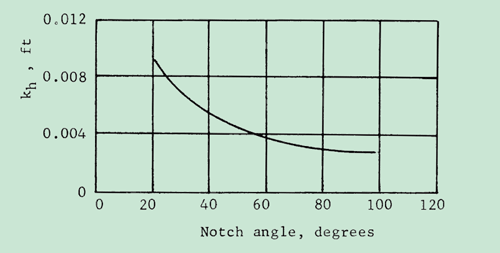
Note that the equation and correction factors apply to fully contracted V-notches. Partially contracted (90º)V-notches rely on different Ce values.

Image: The Devon Karst Research Society
Sources: Kuhlin, G. and Compton, P., A Guide to Methods and Standards for the Measurement of Water Flow, Special Publication 421, National Bureau of Standards, 1975, British Standards Institution, Standard No. 2680-4A, Methods of Measurement of Liquid Flow in Open Channels: Part 4A, Thin Plate Weirs and Venturi Flumes, 1965