
 Green roofs have grown in popularity in the US in the past decade. Popularized in Germany begining in the 1960's, green roofs have shown to provide benefits to the building owners and society as a whole.
From a municipal standpoint, green roofs offer a number of advantages, including:
- Delaying storm water runoff
- Reducing peak storm water runoff flows
- Improvement in storm water runoff quality
- Heat island imtigation
While building owners have experienced:
- Lower HVAC costs
- Increased roof life spans
- Increased real estate values
- LEED credits (from 2 to 7+ points towards LEED-certification)
- Government tax incentives
WIth this popularity comes a desire to best utilize the resouces and materials used in green roof construction.
Key to any evaluation of green roof species or materials is the collection and quantification of runoff from green roof installations and test plots. Open channel and closed pipe flow devices have both been used to measure runoff; with a trend towards the use of lower cost open channel devices over closed pipe devices. Of the open channel devices used, flumes and weirs have been prominent.
The low head loss of flumes translates into the ability to be retrofitted to roofs with little modification to drainage systems. Weir on the other hand require the development of potentially large standing water upstream pools of water adding weight to the installation and utilizing more roof space. Weirs also require about four times more head loss than flumes of a similar capacity.
Green Roof Flume and Weir Examples
Internet research shows that flumes and weirs have been successfully applied
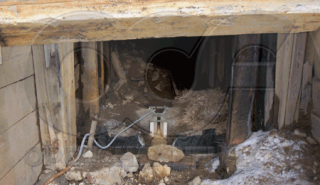
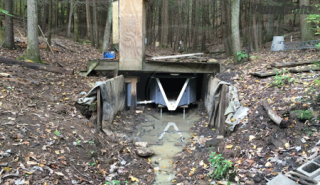
- Carnegie Mellon University - Trapezoidal flume
- Industry (client not listed) - Trapezoidal flumes in enclosures
- EPA Region 8 Headquarters - H flume in enclosure
- University of Maryland - Baltimore - Weir boxes
Flumes
Trapezoidal and H flumes have proven to be well adapted to measuring variable runoff flows from green roofs. The low head loss of flumes translates into the ability to be retrofitted to roofs with little modification to drainage systems.
Advantage of the H flume is that flow conditioners can be readily integrated into the approach section. This can be particularly helpful in vertical downspout applications.
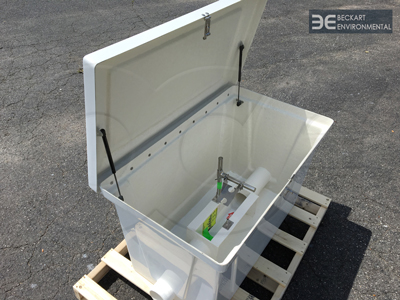
For at grade (or below roofline) applications, Trapezoidal and H flumes have been successfully integrated into fiberglass enclosures for a contained runoff measurement system.
Weir Plates
The need to develop a proper weir pool generally discounts the use of freestanding weir plates. Weir boxes, then, are the only weirs suitable for runoff measurement. Weir boxes are only used in measuring flows off vertical downspouts / gutter systems.
Weir Boxes
The head loss of weirs limits the use of weir boxes. Unless considerable accommodation is made, weir boxes are usually only used to measure runoff from downspouts. Also remember that there are flumes available that are able to accurately measure lower flows than thin-plate weirs.
When using weir boxes it is important to rememer that the pool of water upstream of the weir will act to serve to act as a sediment trap. This feature of weirs - usually a drawback - can be an advantage if sediment trapping is desired. Sediment trapping can be used as an indicator of green roof health (similar to dam seepage applications) where changes in the sediment load or composition can be indicators of the performance of green roof materials and plant materials.
The selection of runoff monitoring location is a function of the drainage collection method, anticipated flows, and device selected. Not all locations are suitable for all green roofs.
In partiuclar pitched green roofs may necessiate the use of a central collection gutter and then the flume or a collection gutter, a downpout and then the flume.
Image: EPA - Region 8
Sources: Carothers, D., Dzombak, D., Development of a Green Roof Stormwater Monitoring Protocol and Green Roof Stormwater Modeling Tool, Carnegie Mellon University, December 2005, Greenrooftechnology.com