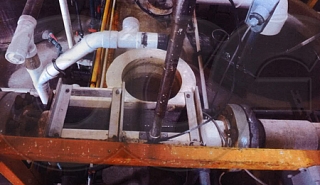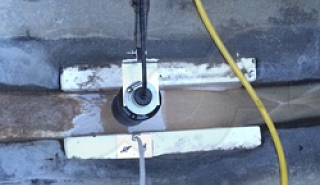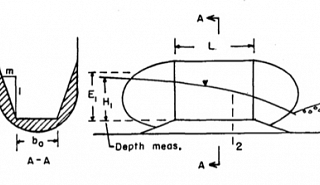

Over the years several different styles of Palmer-Bowlus flume have come into the marketplace, including the Insert style. While the original Palmer-Bowlus flume was intended to be used in-line with piping, the Insert style is intended to nest into an existing pipe – not in-line with it.
Why an Insert Style?
Before area velocity and other portable flow meters, the Insert style Palmer-Bowlus was the device used most often to conduct temporary flow studies in manholes.
In manholes where a U-channel has already been formed, the Insert style Palmer-Bowlus allowed the operator to install the flume in the channel with minimal effort – all that needed to be done was to make sure the flume was level and to seal around the flume so that water didn’t bypass it.
The Problem with the Insert Style
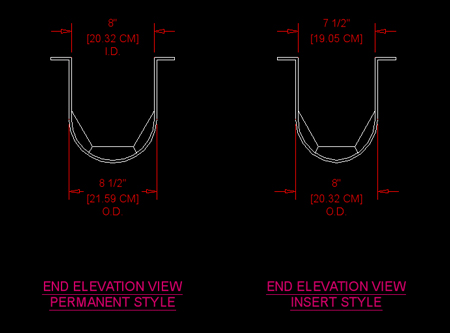
The fundamental problem with the Insert style Palmer-Bowlus flume is that unlike the Permanent style Palmer-Bowlus which has an ID of a given size (i.e. 8-inches), the Insert Style has an OD of a given size (i.e. 8-inches).
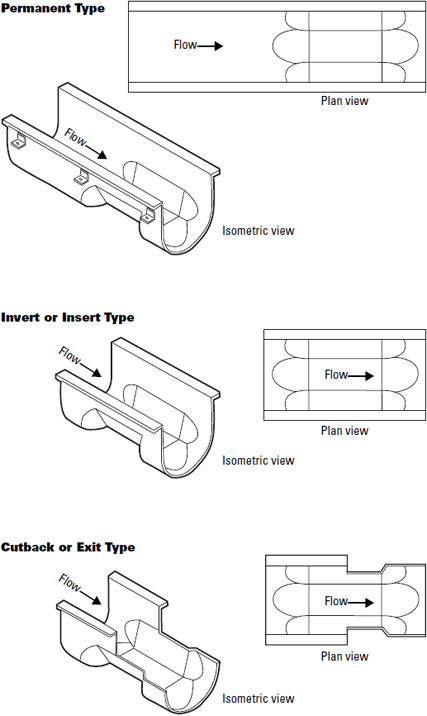
To allow the flume to nest into a pipe the walls of the flume have to be brought in by the wall thickness on each side. For fiberglass flumes this usually means ¼-inch on each side – ½-inch overall. The below diagram shows the difference between the two styles.
What The Reduced Cross-Section Means?
Comparing the two Palmer-Bowlus styles above, the Permanent style has a cross-sectional area of 46.41 sq-inches. The Insert style has a cross-sectional area of 43.07 sq-inches. A difference of 7.2%. So for a given amount of flow, the Insert style will have a higher head than the Permanent style.
Keep in mind that the flow tables for Palmer-Bowlus flumes are rated for the Permanent style. They are not rated for any other style – although they are frequently used for them.
So an Insert style generates more head for a given flow rate than a Permanent style and the flow tables for Palmer-Bowlus flumes are based upon the Permanent style flume. Therefore, the Insert style installation will ALWAYS OVERINDICATE the flow rate when compared to the Permanent style installation. This difference is not constant as the difference in cross-sectional area varies by flow level – with more proportional difference at lower heads than at higher heads.
Image: Teledyne Isco