
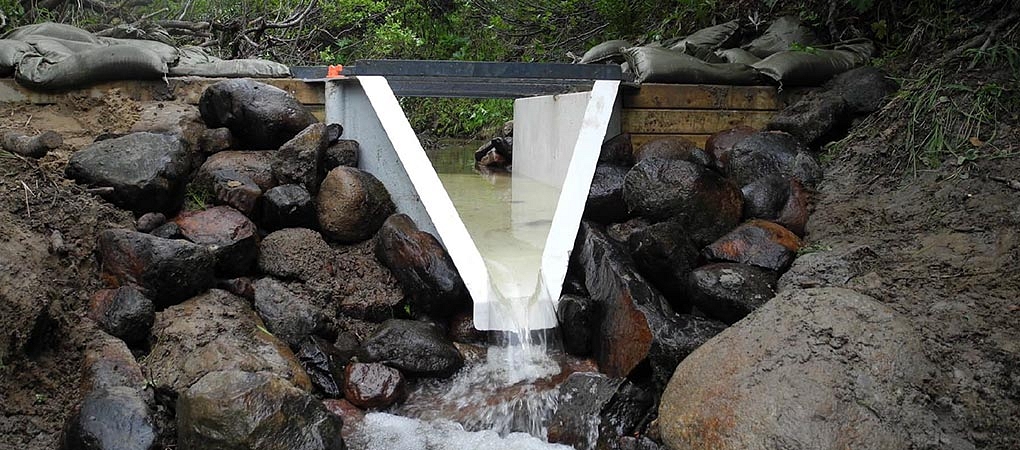
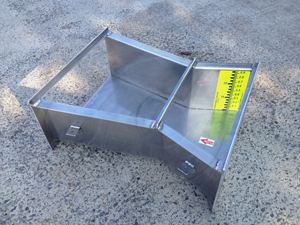
 Aluminum Cutthroat Flumes can be a good choice where resistance to abrasion or physical damage is required but where the flume must be light enough to move from site-to-site or to a remote area. Aluminum Cutthroat Flumes are most commonly used to measure dam seepage, remote watersheds, and mine dewatering flows.
Both Rectangular and Trapezoidal Cutthroat Flumes are available in aluminum construction.
Aluminum Advantages
Aluminum Cutthroat Flumes are fabricated from 5052 aluminum and:
- Have good resistance to abrasion / damage
- Are light weight
- Have tight dimensional tolerances
- and are available with a selection of accessories and mounting / end configuration options
Abrasion / Damage Resistance
The heavy-duty construction of Openchannelflow aluminum Cutthroat Flumes provides good resistance to both abrasion by flow stream sediments and damage by physical abuse. This resistance to damage is particularly useful in mine dewatering applications.
Light Weight
Aluminum Cutthroat Flumes weigh less than similarly sized fiberglass ones - about 2/3rds - meaning that they are easily handled, are more portable, and require less manpower / equipment to install than Cutthroat Flumes constructed of other metals.
Dimensional Tolerances
Skilled metal fabrication means that aluminum Cutthroat Flumes can have dimensional tolerances of:
Throat
-
1/16-inch [1.59 mm] (12-inches or smaller Cutthroat Flumes)
-
3/32-inch [2.38 mm] (18-24-inch Cutthroat Flumes)
-
1/4-inch [6.3518 mm] (36-72-inch Cutthroat Flumes)
While larger Cutthroat Flume sizes are available, it is uncommon to see them constructed out of aluminum due to cost.
Configuration Flexibility
Aluminum construction does not lend itself to as many accessories or mounting / end configuration options as stainless steel or fiberglass Parshall Flumes, but many of the more common ones are available.
Contact Openchannelflow for additional details.
