

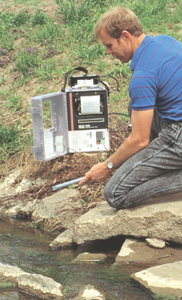
 A submerged probe (pressure transducer) flow meter has a probe that is placed in the flow stream at the bottom of the primary device or channel. The probe contains a pressure transducer to measure the weight of the water column over the probe. From that, the depth of the water is easily calculated.
Most submerged probes have a venting system to allow for automatic compensation for changes in the atmospheric pressure for maximum accuracy. Without such venting, the indicated water level would vary as the atmospheric pressure changed - regardless of any actual change in the water level.
To allow level readings down to zero, a submerged probe must be below the floor of the flume or channel. In a flume, this is most frequently accomplished through the use of a probe well (which typically extends 3-inches [7.62 cm] below the floor of the flume).
Submeged probe flow meters provide accurate level measurements at sites that would otherwise be affected by wind, steam, foam, turbulence, or air temperature fluctuations.
Image: Teledyne ISCO
