

If wing walls are necessary to transition flow smoothly into a flume, the wing walls should be radiused and the not flat 45° walls commonly specified (other than for Trapezoidal or RBC flumes where the geometries are such that radiused walls would be quite difficult to fabricate).
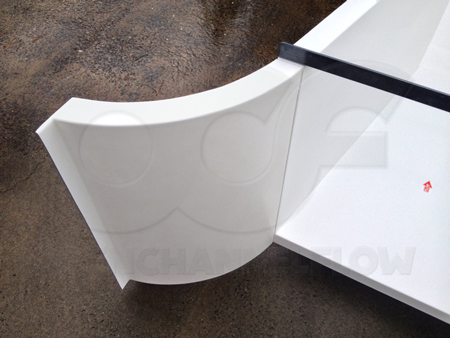
Parshall flume research has shown that 45° flat inlet wing walls generate a standing wave and a wave trough downstream of the point of intersection between the wing wall and the flume wall.
For the flume size investigated, at heads above 60% of the flume depth, the standing wave trough extends far enough downstream to markedly affect the head readings. Radius wing walls can help to retard or eliminate the formation of the standing wave.
