

Under laboratory conditions, a properly installed Weir can typically achieve accuracies of +/-2 to 5%; under most field conditions accuracies within 5 to 15% may be expected.
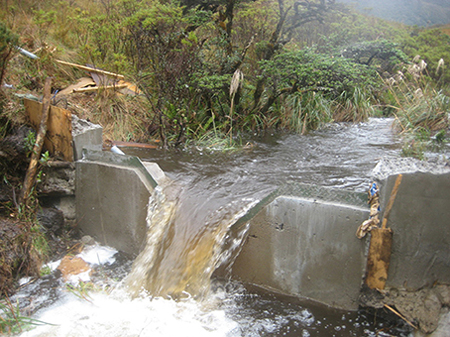
However, the overall accuracy obtained from the flow measurement systems (the weir and flow meter) can be affected by a number of factors, including: faulty construction or installation of the weir, improper head measuring location, incorrect zero setting of the flow meter, flow meter level measurement inaccuracies, flow meter level-to-flow conversion inaccuracies, use of the weir outside its proper range, improper maintenance of the weir, and turbulence and surges in the approach channel.
Weirs crests should be free of rust and nicks. Any form of roughness will cause the weir to discharge more water than indicated in the standard discharge tables. Additionally, air should circulate freely under the nappe. An increase in discharge as much as 25% may occur if the nappe is not properly ventilated.
Image: Frontiers in Earth Science
