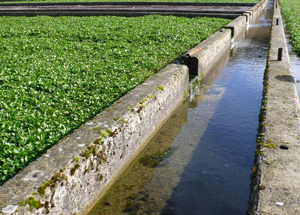
 One way of calculating open channel flow in pipes and channels without using a flume or weir is the Manning Formula. Although not as accurate as a hydraulic structure, the formula can provide a sufficient level of accuracy in some applications.
Measurement Conditons
For best results with when applying the Manning formula:
- The channel should be straight for at least 200 feet (and preferrably 1,000 feet)
- The channel should be uniform in cross-section, slope, and roughness
- There sould be no rapids, dips, sudden contractions / expansions, or tributary flows
- The flow should not backup or be submerged
Manning Formula
The Manning formula uses water surface slope, cross-sectional area, and wetted perimeter of a length of uniform channel to determine the flow rate.
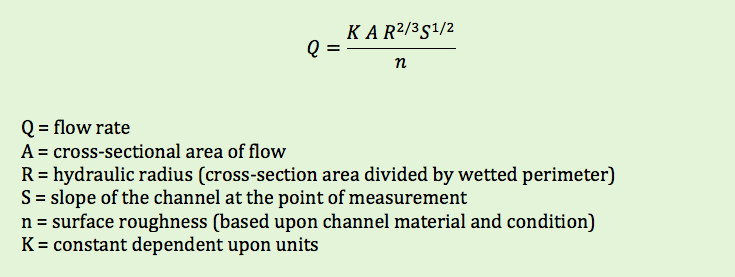
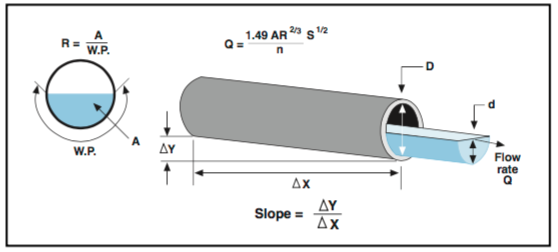
The cross-section area (A) and the hydraulic radius (R) are calculated for the given depth of the liquid in the channel at the moment of measurement (and not at some arbitrary maximum or minimum condition).
The slope (S) often has to be estimated based upon previous installation drawings of the channel or pipe, but true site measurements will provide a more accurate flow rate.
The roughness coefficient (n) is selected from standard reference roughnesses based upon the channel / pipe material and its condition.
Roughness Coefficients (n)
Nummerous n-values have been calculated for a variety of streams, channels, and pipes. Usuallly the values are given as a range (minimum - normal - maximum) for a particular channel type or material.
There are numerous factors that affect n-values, including:
- Surface roughness
- Vegetation
- Silting / scouring
- Obstruction
- Size / shape of channel
- Seasonal change
- Suspended material
- Bed load
- Stage (depth of flow)
- Discharge
Tables for various n-values can be found online at the Corvallis Forestry Research Community site (from Chow, 1959 and AISI, 1980). A guide to selecting Manning's roughness coefficients for natural channels and flow plains is available from the U.S. Department of Transportation here.
Accuracy
Under ideal conditons, the Manning formula can acheive accuracies of +/- 10-20%. However, variances in the above measurement conditons means that accuracies of +/- 25-30% are more likely, with errors of 50% or more possible if care is not taken.
Image: Wikimedia Commons, Open Channel Flowmeters
Sources: Corvallis Forest Research Community, Open Channel Flowmeters