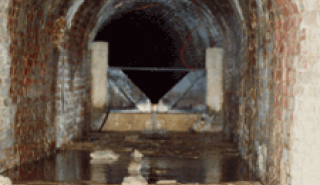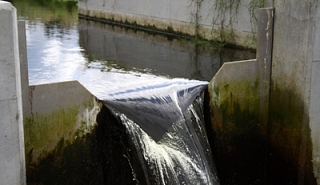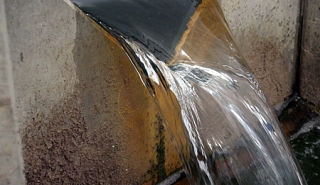

Weirs, like flumes, work by accelerating slow, sub-critical flow (Fr<1) to faster moving, super-critical flow (Fr>1). The acceleration develops a know relationship between level and flow upstream of the weir itself.
But what happens when the flow approaching the weir isn’t sub-critical, but instead is critical or super-critical. Will the weir still operate as usual?
The Iowa Institute of Hydraulic Research answers that question in their video entitled Fluid Motion in a Gravitational Field.
Flow Visualized
Under sub-critical, free-flow conditions with the nappe fully aerated, the flow over a thin plate weir looks like the below (Fr = 0.5).
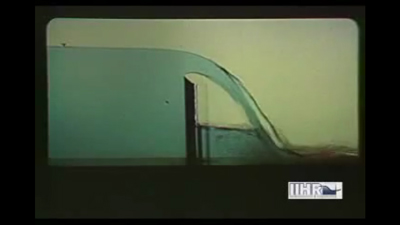
However, as the velocity of the approaching water increases (Fr > 1), the flow overshoots the weir.
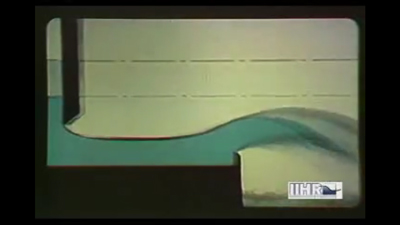
As the velocity increases the overshoot becomes even greater.

Note that the water level at sub-critical flow is substantially higher than that above unity (Fr = 1).
While this example is dramatic for effect, the implications are clear: excessive approach velocities approach thing plate weir must be controlled in order for the weir to function properly.
The video can be view in its entirety below:
Source: Iowa Institute of Hydraulic Research