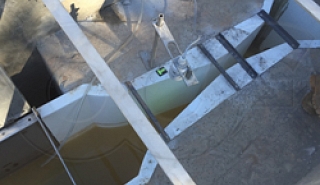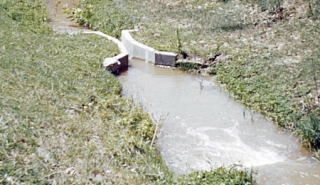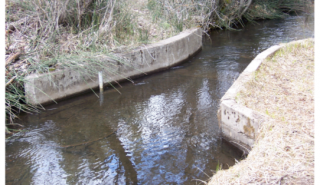

The purpose of a Parshall flume is to measure the flow of water in an open channel (or non-pressurized pipe).
This water can be from a variety of sources, including: rivers, streams, canals, channels, field runoff, mine discharge, dam seepage, springs, wastewater, and industrial discharges.
How a Parshall Flume Helps to Measure Flow
The Parshall flume has an hour glass shape. Water enters the converging section of the flume and is accelerated from a slow, subcritical state, to a fast, critical / supercritical one as it enters the throat (narrowest portion) of the flume.
It is this acceleration of flow from subcritical to supercritical that developers the level-to-flow relationship.
As a short-throated flume, the point of measurement (Ha) where the level-to-flow relationship exists is at a single defined point in the converging section of the flume - upstream of the narrow throat. The point of measurement is NOT in the throat or any other location in the flume. While there is a secondary point of measurement (Hb) located in the throat of the flume, that location is ONLY used in determining the level of submergence (restriction of flow out of the flume) and NOT for free flow through the flume.
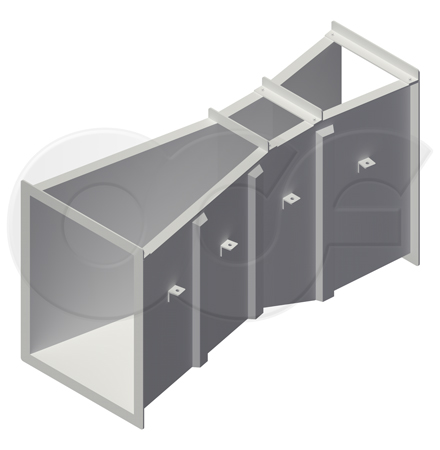
Parshall flumes can only be used to measure slow, subcritical flows (as their operation results in accelerating flow from one state to another) and that the flow be under open channel (non-full pipe / unpressurized conditions). In applications where the water does not flow with a free surface, a Parshall flume should not be used.
Types of Flows Parshall Flumes Measure
Parshall flumes are used to a wide range of flow, including:
- Surface waters
- Storm water
- Wastewaters
Parshall flumes should not be used to measure liquids with physical properties substantially different than water.